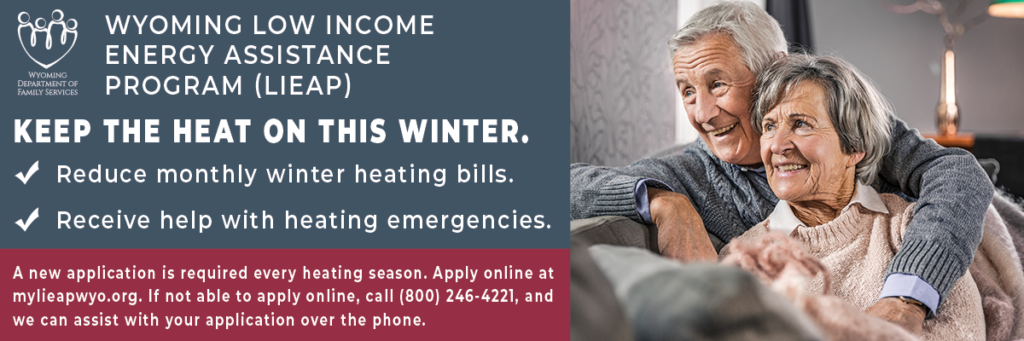
LIEAP is now accepting applications.
The Wyoming Low Income Energy Assistance Program (LIEAP) is a federally funded program that helps eligible residents cover a portion of their monthly winter heating bills, receive help with heating emergencies, and improve their home’s energy efficiency. A new application is required every heating season. Apply online between October 1, 2026 – April 30, 2027. If you can’t apply online, call (800) 246-4221, and the LIEAP team can help with your application over the phone.
For assistance, the LIEAP team is available to answer questions. The phone number for LIEAP is (800) 246-4221 or email lieapinfo@wyo.gov. Due to high call volumes, response times may be longer than usual. Our team is working diligently to assist everyone as promptly as possible.
2026 Changes to LIEAP
Please note that the short URL for LIEAP has been changed to MYLIEAPWYO.ORG.
- Payments: LIEAP can issue payments for utility bills in October. Your seasonal LIEAP benefit will not pay bills from before October 1, 2026.
- Unpaid Bills: If you have a disconnect notice on your utility bill from the last 30 days, you can get help. You can receive help with up to two utilities, with one payment for each during the season.
- Crisis Assistance: Effective October 1, households requesting crisis assistance must show they recently made an active effort to pay their energy bills. To qualify, they must have made at least one verifiable payment toward their primary utility, secondary utility or both within the past 60 days. If this cannot be verified, the client is not eligible for crisis assistance.
Resources
- About LIEAP Handout: Learn about LIEAP. Download About LIEAP handout (PDF)
- Registration Guide: If you do not already have an account with LIEAP, HAF, or ERAP, learn how to create an account so you can apply. Download Registation Guide (PDF)
- Application Guide: Step by step instructions on how to fill out an application. Download Application Guide (PDF)
- Reapplication Guide: Did you receive a denial from LIEAP? If your application was denied for failure to provide the requested verifications or if your household now has less income, you may reapply. Download Reapplication Guide (PDF)
Program Information
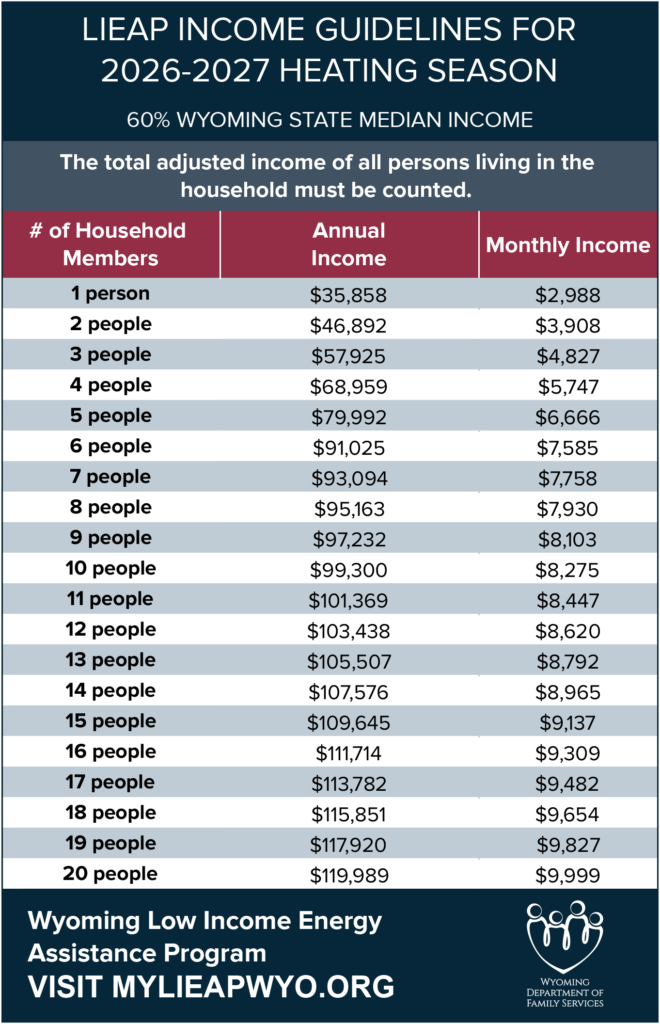
Frequently Asked Questions
More Information About Wyoming LIEAP
LIEAP is funded through a federal block grant program by the U.S. Department of Health and Human Services and administered by the Wyoming Department of Family Services.
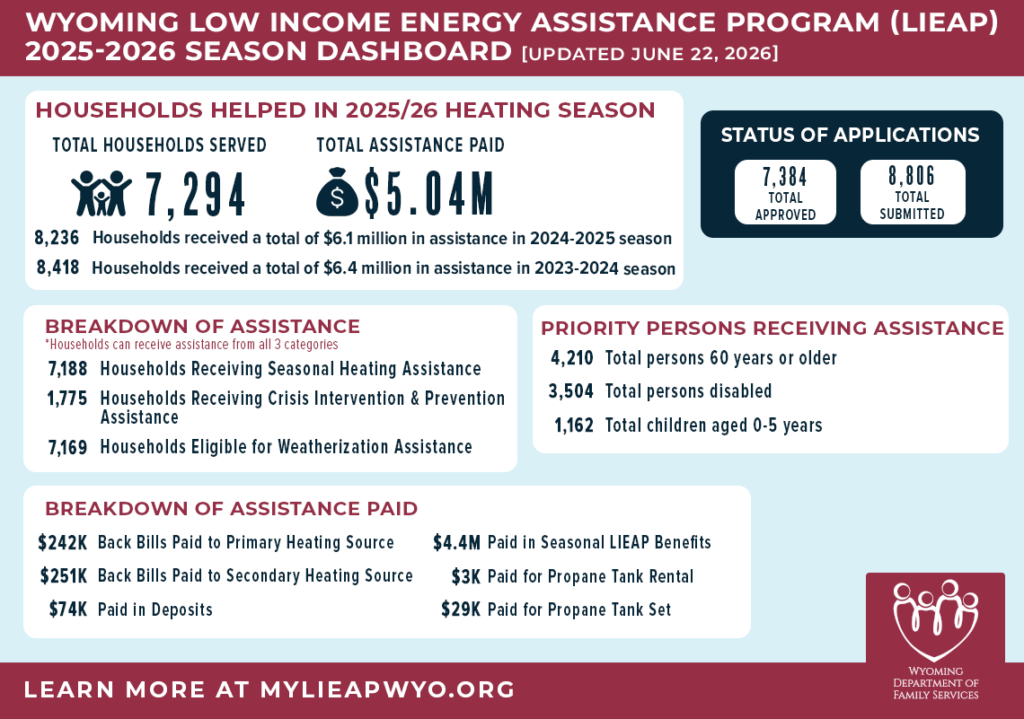
Dashboard for 2025-2026 Heating Season
This website is supported by Grant Number 2501WYLIEA from the Low Income Home Energy Assistance Program within the Administration for Children and Families, a division of the U.S. Department of Health and Human Services. Neither the Administration for Children and Families nor any of its components operate, control, are responsible for, or necessarily endorse this website (including, without limitation, its content, technical infrastructure, and policies, and any services or tools provided). The opinions, findings, conclusions, and recommendations expressed are those of the author(s) and do not necessarily reflect the views of the Administration for Children and Families and the Low Income Home Energy Assistance Program.