The Wyoming Early Childhood Integrated Data System (WY ECIDS) combines publicly available census data with child and provider level data from multiple early childhood education programs to gain a more complete picture of the early childhood landscape in Wyoming. The integrated data is used to describe the market for early childhood education services and understand patterns in service delivery and outcomes. The ECIDS is a collaborative project between the Governor’s Office, Wyoming Department of Family Services (DFS), Wyoming Department of Education (WDE), and the Wyoming Department of Health (WDH).
This site features two ECIDS data products – Wyoming child care access desert maps and Wyoming early childhood fact sheets.
Wyoming Child Care Access Desert Maps
Child care access deserts can affect affordability, access, and care coordination for families and caregivers with children ages birth to five years old.
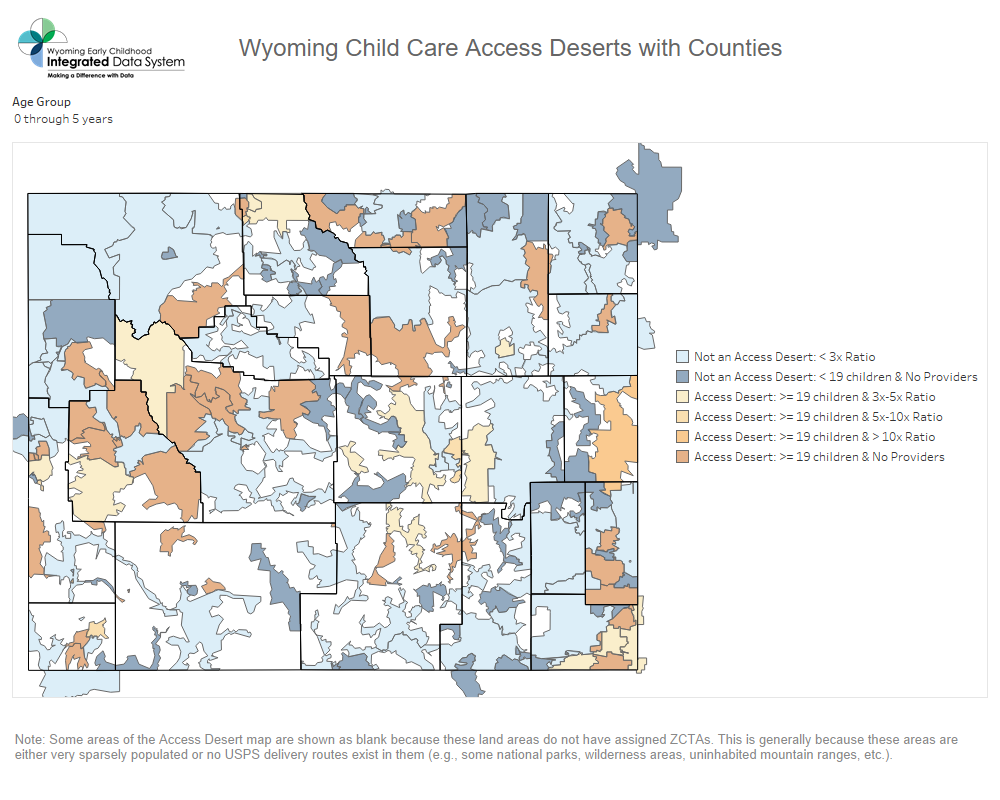
What is a child care access desert?
A child care access desert is any geography where the supply of licensed child care is insufficient to meet demand.
The term and methodology were developed by the Center for American Progress in 2016. They compared the child population to the number of licensed child care slots by census tract. A ratio of 3:1 means there are three children for every licensed child care slot. Geographies with ratios higher than 3:1 are considered to be access deserts, and geographies with ratios lower than 3:1 are not access deserts. The above map uses zip code tabulated areas (ZCTAs), which are generally equivalent to zip codes and follow U.S. Postal Service delivery routes. Click here for a list of Wyoming ZCTAs and their associated child care access desert rating.
Why a 3:1 ratio?
Family choice is important; not all families will need or want licensed child care and many families will use some combination of formal and informal care to meet their needs. The 3:1 ratio comes from a 2011 national survey by the U.S. Census Bureau which found that 1 in 3 children under five years old were regularly in some form of non-relative care – primarily day cares, preschools, family child care homes, and Head Starts, etc.
What data is used in Wyoming?
Wyoming’s data comes from the Wyoming Early Childhood Integrated Data System (WY ECIDS), which uses 3Si’s Child Universal Success Platform (CUSP) to integrate census data and state administrative data to model early childhood populations and service utilization. Licensed capacity is from a combination of the Wyoming Department of Family Services’ child care licensing data (for number of licensed child care slots) and the 2024 Market Rate Survey (to estimate the number of slots available by age group, which is not captured in licensing data). Population estimates are from U.S. Census Bureau survey data and should not be interpreted as exact counts. The data displayed in this map is as of August, 2025.
For more information about child care access deserts or the WY ECIDS, please email wyecids@wyo.gov.
Wyoming Early Childhood Fact Sheets
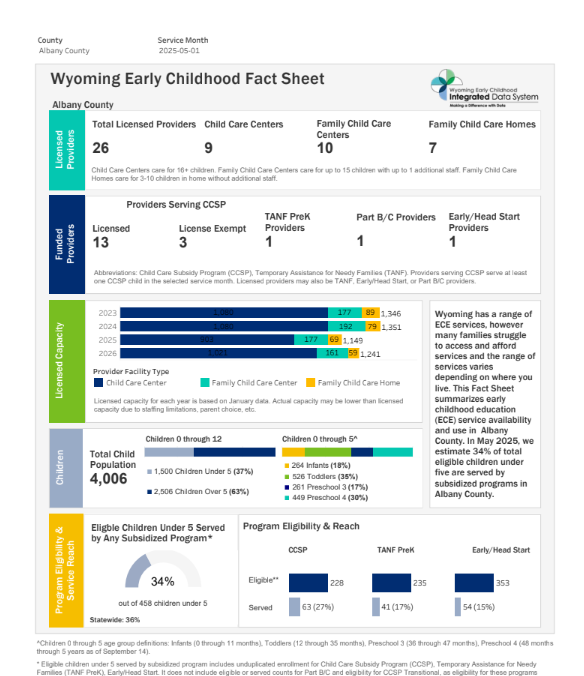
The Wyoming Early Childhood Fact Sheets offer county-level data on the state of child care in Wyoming. They provide a quick reference for:
- Child Care Providers: The number and types of licensed providers, as well as the number of providers serving children through subsidized funding programs.
- Licensed Capacity: The total authorized number of children that licensed facilities can serve.
- Child Population: Estimated population counts for children aged 0–12, broken down by specific age groups.
- Program Reach: A comparison of the estimated number of children eligible for major subsidized programs (Child Care Subsidy Program (CCSP), or child care assistance; Early Head Start/Head Start; and Temporary Assistance for Needy Families (TANF) Preschool) versus the actual count of children being served.
- Location: A map showing the percentages of licensed providers who received CCSP on behalf of an eligible child by county.
Fact sheets are available for two time points: May 2026 and January 2026.